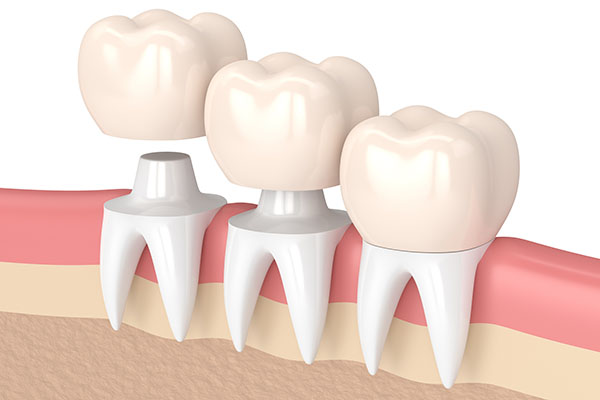
One of the first rules of dentistry is that it is best to save the natural tooth whenever possible, such as with a dental crown. However, a procedure is an effective alternative when this is not an option. If you are unsure which is right for you, our general dentist can help. They will evaluate your dental condition and then recommend one of these two options to restore your smile.
What is a dental crown?
Dental crowns restore damaged teeth. They fit over the tooth like a cap, making them an effective restoration for teeth that will not improve with dental bonding. Since bonding simply fills in the damaged area of the tooth (such as in the case of a cavity filling), crowns are a better option when there is moderate to severe damage to the tooth.
There are many types of dental crowns. Some are tooth-colored, enabling them to blend in with the rest of the teeth. All-ceramic or porcelain dental crowns are increasingly popular for this reason. Metal crowns are another common option, but they are silver in appearance. This makes them more noticeable.
When to get a dental crown
A general dentist may recommend a dental crown for various reasons. The most common is restoring a weak, cracked, chipped, or decayed tooth. For example, patients typically receive a crown after root canal therapy. They may also act as a component of other restorations, such as dental implants or bridges.
About tooth extraction
Tooth extraction is a common procedure in which the tooth is pulled out completely. This does not mean that the patient has to live with a missing tooth, however. A general dentist may recommend an implant, bridge, or other restoration. Not only will this restore the patient’s full bite force, chewing ability, and smile, but it will also save the jawbone from deteriorating.
When extracting a tooth is recommended
A general dentist will only recommend tooth extraction as a last resort. It is standard practice in the dental industry to save as much of the natural tooth structure as possible. Therefore, the dentist will first consider a dental crown and, if not an option, will recommend tooth extraction.
Dental conditions requiring tooth extractions include teeth that cannot erupt properly (impacted teeth), severe gum disease or tooth decay (cavities), and deep tooth fractures. However, the tooth does not have to be severely damaged to warrant a tooth extraction. For instance, crowded teeth may also require an extraction to create space and allow orthodontic treatment.
The bottom line
A general dentist will evaluate the health of the tooth as well as its placement when recommending either dental crowns or tooth extraction. The more severe the damage, the more likely a crown will not do the job on its own. In such cases, the dentist would recommend tooth extraction and a follow-up dental restoration.
Call today for an appointment
For more severe dental issues, tooth extraction may be the best option. Other times, a crown will be sufficient. Meet with a general dentist to discuss which is best for you. To schedule an appointment, call our office in Miami.
or call Feel Good Dentistry at 305-230-4484 for an appointment in our Miami office.
Related Posts
Tooth extraction can apply to an impacted tooth. This tooth can cause pain and other dental problems. Your dentist may suggest the removal of this tooth after a thorough assessment. Here are the details to consider if your impacted tooth needs extraction.The main goal of dentists is to keep teeth intact. They will only remove…
You may need a tooth extraction to improve your oral health. Preserving teeth is the primary goal of dentists. But there are cases when removing the tooth is important in achieving good dental health. Here are the details on when it is necessary for one’s oral health to get a tooth extraction.Tooth extraction may be…
Many conditions can result in a tooth extraction, all of which boil down to the state of the tooth. There are two main types: simple and surgical. Take a closer look at each option and why we may recommend them.The goal of any general dentist is to preserve the natural teeth for as long as…